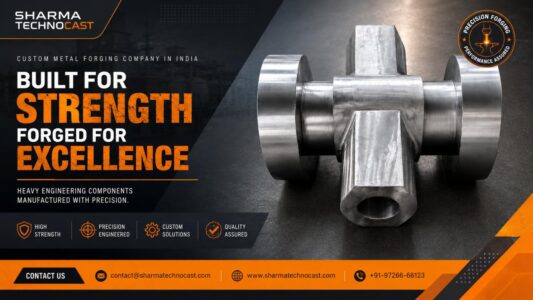


A specification that says quench and temper to a given tensile strength is straightforward on a 60mm shaft and can be physically impossible on a 400mm one. The reason is that quenching cools the surface fast and the core slowly, because heat from the centre has to travel out through everything around it. Below a certain cooling rate the steel doesn’t transform to the intended structure, so the core ends up softer and weaker than the surface no matter how aggressive the quench. Getting properties through a heavy section is a hardenability question, which means it’s a grade question. Chromium and molybdenum additions slow the transformation and let the steel harden at lower cooling rates, which is why heavy forgings move to alloy grades rather than heavier doses of carbon steel. Specifying a strength level without checking it against the section thickness is how a forging order ends up asking for something the metallurgy won’t deliver. A Custom Metal Forging Company in India working on heavy engineering should raise that at enquiry rather than after heat treatment. Sharma Technocast produces heavy engineering forgings with heat treatment, machining, and ultrasonic testing in-house. For heavy forging requirements, contact Sharma Technocast directly. contact@sharmatechnocast.com +91 9726666123